
Project ISSconALICE
Program 5.9/5.9.2/CERN-RO
Funding agency: IFA
Project period: 25.11.2024 – 31.12.2026
Project Director: Dr. Alexandru Florin DOBRIN
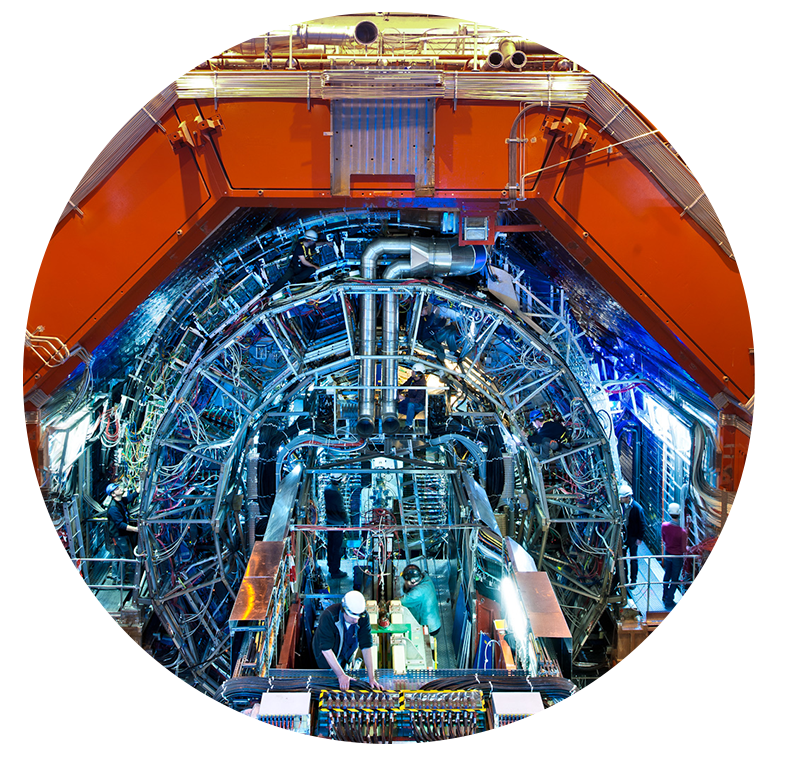
ISS contributions to ALICE physics, computing and hardware/ ISSconALICE
Project description
The main goal of this project is to study the system created in collisions of hadrons and nuclei recorded by the ALICE detector at the Large Hadron Collider (LHC) using measurements of angular correlations between the produced particles. The key objectives are to constrain some of the basic properties of the quark-gluon plasma (QGP), a deconfined system of quarks and gluons, in Pb-Pb collisions, to probe the formation time of different particle species in different collision systems (e.g., Pb-Pb), to look for parity violating effects in quantum chromodynamics (QCD), and to understand the origin of collective effects observed also in small collision systems (e.g., p-Pb). The Physics Data Processing and the GRID activities will be continued since they provide additional resources to pursue the key objectives. Furthermore, the involvement in the development of the Readout Unit (RU) firmware of the forward calorimeter (FoCal) as an upgrade to the ALICE detector in the Long Shutdown 3 (2026-2029) will allow us to further study the origin of long-range flow-like correlations in p-Pb collisions and will increase the visibility in ALICE. The gained experience will be used for a future contribution on the hardware side to the ALICE 3 detector. Last but not least, various outreach activities will be carried on to present the research at an informational and educational level to the professional community, the science policy makers, and the general public. The study of angular correlations is established as one of the most powerful tools that can provide direct information about the QGP properties. This can be achieved by measuring azimuthal correlations of inclusive and identified particles with the symmetry plane, often referred to as anisotropic flow, and the balance function for identical and non-identical particles. In addition, exciting new physics can be extracted by investigating the existence of parity violating effects in QCD, which are allowed by the theory but they have never been experimentally observed (the so-called strong-CP problem). These important properties will be addressed by measuring charge-dependent azimuthal correlations (i.e., pairs of particles with same and opposite charge) coupled with Monte Carlo calculations of the magnetic field.
Project team
- Project director: Dr. Alexandru Florin DOBRIN
- Member: Dr. Catalin Lucian RISTEA
- Member: Dr. Andrea DANU
- Member: Dr. Adrian SEVCENCO
- Member: Dr. Madalin Ilie CHERCIU
- Member: Dr. Ionel STAN
- Member: Drd. Alexandru MANEA
- Member: Catalina Diana BRANDIBUR
- Member: Maria LINC